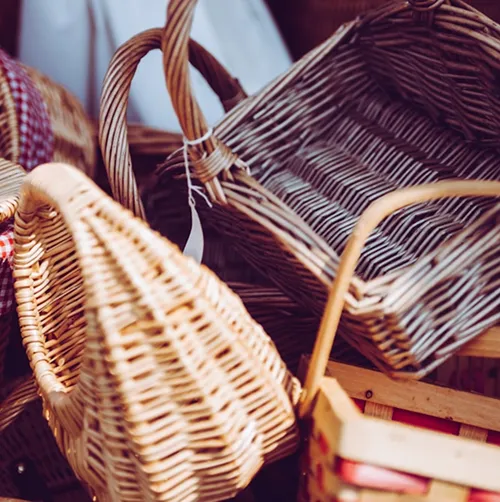
Before plastic and cardboard, nearly everything on an Irish farm was carried in a basket: turf from the bog, potatoes from the field, fish from the boat. Most of them were woven from willow.
Irish basket makers call willow sallies, from the Irish saileach. A good basket maker could turn a bundle of rods into a creel strong enough to carry a load of wet turf, using nothing but their hands, a knife and a bodkin. It’s a craft that takes an afternoon to start and a lifetime to master.
A countryside glossary
Baskets with Irish names
- SaileachThe sally
- Willow, the basket maker’s material. Most farms once kept a small sally garden of it by the house, cut every winter.
- CliabhThe creel
- For carrying turf from the bog, on a person’s back or slung in pairs across a donkey. Some had a hinged bottom to tip out the load.
- CiseogThe skib
- A round, shallow basket for straining boiled potatoes, which were then set in the middle of the table to share.
- Pots and traps
- Along the coast and the rivers, willow was woven into lobster and crab pots, and into traps for eels.
From sally garden to basket
Seven steps
Winter
Cut
Willow is cut while it’s dormant, between leaf fall and spring.
Winter
Sort and dry
The rods are graded by length and stored to dry, ready for use all year.
Before weaving
Soak
Dried rods are soaked in water until they bend without cracking.
The base
Slath
A cross of thick sticks is tied and woven round to make the base.
The sides begin
Upsett
Stakes pushed in round the base are bent up to form the sides.
The sides
Weave
Rods are woven in and out of the stakes, round and round, to the height you want.
To finish
Border
The stake ends are woven down into a border that locks the whole basket together.
Down by the salley gardens my love and I did meet;
She passed the salley gardens with little snow-white feet.
Learn it by hand
Join a basket making workshop
Get in touch to ask when our next basket making workshop is on, or about bringing one to your school, club or community group.