A skep is a hive made from coiled straw. For centuries, it was how bees were kept in Ireland, and a well-made one could last a lifetime.
Making one takes little more than straw, a strip of bramble and patience. The maker builds it up coil by coil, from the crown down, stitching each round to the last, until it’s the right size for a swarm. The shape keeps the bees warm and dry, and it’s much the same shape bees choose for themselves in a hollow tree.
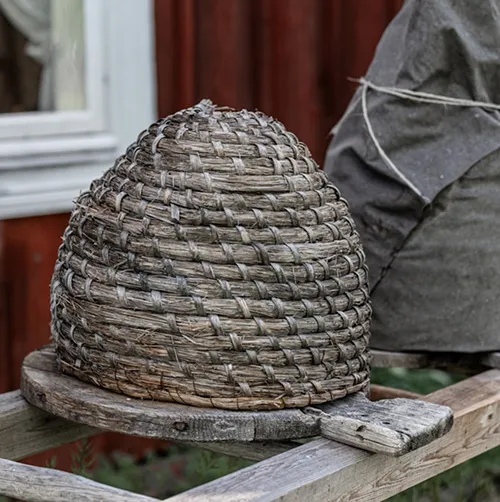
How it’s made
Anatomy of a skep
Coils of straw
Long straw, or rushes, fed through a gauge (often a ring of horn or leather) so every coil is the same thickness.
Binding
Thin strips of split bramble or willow, stitched through each new coil and the one beneath it with an awl.
The entrance
A small arch left in the bottom coil, just big enough for the bees and easy for them to guard.
The board
A flat stand to sit on, kept off the damp ground. Skeps were often set in a sheltered spot, or in a niche in a wall.
Bechbretha
Ireland’s bee laws
Bees mattered so much in early Ireland that they had their own law. Bechbretha, the “bee judgements”, was written down in the middle of the seventh century, and a copy survives in the library of Trinity College Dublin.
Who owns a swarm
Rules for a swarm that leaves one person’s hive and settles on another person’s land.
A share for the neighbours
Bees feed on the flowers of the land around them, so the neighbours were owed a share of the honey.
Bees that trespass
Unusually, the law treated bees as livestock that could trespass, and set out what was owed when they did.
Legend says Saint Modomnóc brought bees to Ireland from Wales in the sixth century, but the words used for bees and beekeeping in Irish suggest people kept them here long before.
Then and now
The skep and the frame hive
The skep
- Getting the honey
- Often meant killing the colony, or driving the bees out, at the end of the season.
- Seeing inside
- The comb is fixed to the walls, so you can’t look at the brood.
- Today
- Still loved for catching swarms, and for display.
The frame hive
- Getting the honey
- Frames of honey are lifted out, and the colony carries on.
- Seeing inside
- Every frame comes out, so brood and disease can be checked.
- Today
- What almost every beekeeper uses.
Frame hives reached Ireland in the late 1800s. Being able to lift out every frame is why beekeepers today can check their colonies for disease, as our Bee health pages explain.
Learn it by hand
Join a skep making workshop
Get in touch to ask when our next skep making workshop is on, or about bringing one to your school, club or community group.