Every flake of beeswax is made by the bees themselves, from glands on their bodies, to build the comb. A beeswax candle burns slowly and brightly, and smells faintly of honey.
Bees use a great deal of honey to make a little wax, so it has always been precious. For centuries it lit churches and better-off homes, while most people made do with smoky tallow or rushlights dipped in fat. Today, wax from your own hives, or a local beekeeper’s, makes some of the loveliest candles there are.
Three ways to make a candle
Rolled, dipped or poured
Rolled
Good for Children, and a first go
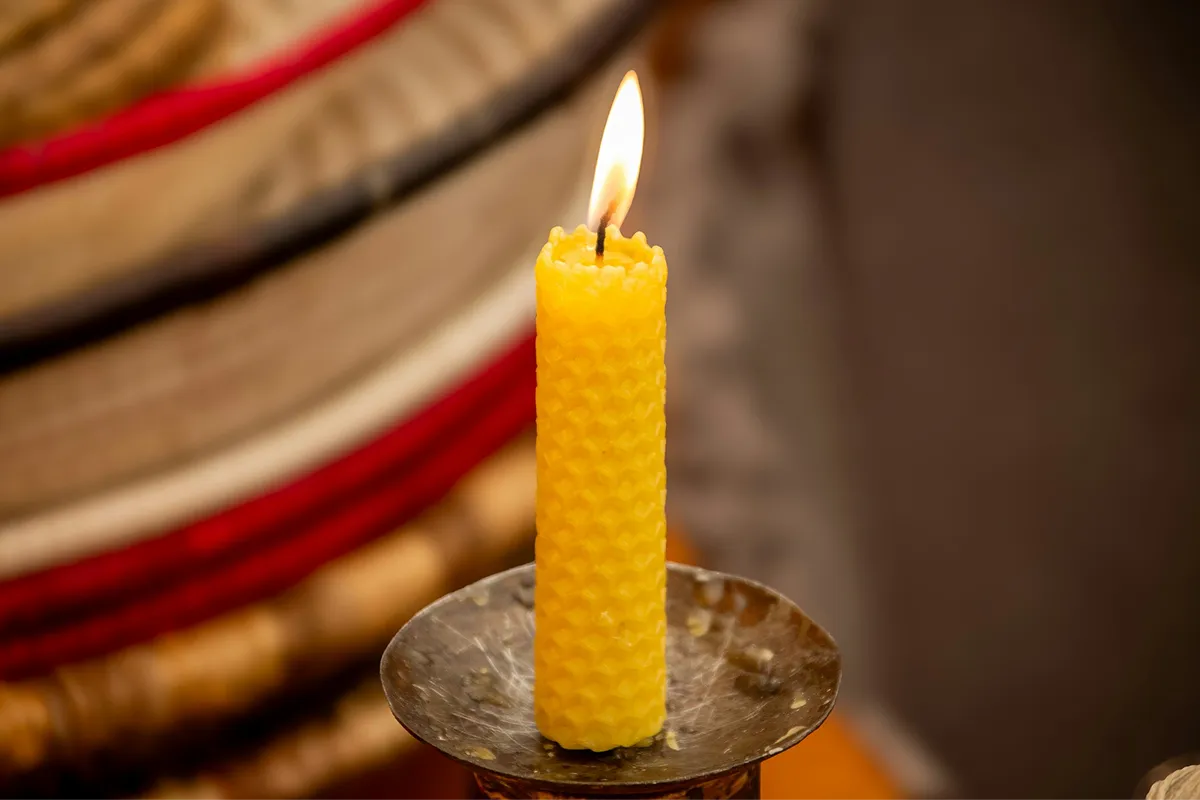
A sheet of beeswax, pressed with the honeycomb pattern, is warmed in the hands and rolled tightly round a wick. No melting, no heat, and a candle in minutes.
Dipped
Good for Tall, tapering candles
A wick is dipped into melted wax, lifted out to cool, and dipped again, dozens of times. Each dip adds a thin layer, and the candle grows slowly into a taper.
Poured
Good for Pillars and shapes
Melted wax is poured into a mould around a wick and left to set. Moulds can be plain cylinders or anything from a skep to a pine cone.
Mind the temperature
Beeswax by the degree
- About 200°C
Flash point
Wax this hot can catch fire. You should never get anywhere near it.
- 100°C
Water boils
Melting wax over a pan of simmering water keeps it safely below this.
- Over 85°C
Too hot
The wax darkens and loses its honey scent.
- 70–80°C
Pouring and dipping
The working range: runny enough to pour, cool enough to build up in layers.
- 62–64°C
Beeswax melts
It turns from solid to liquid in this narrow range.
Learn it by hand
Join a candle making workshop
Get in touch to ask when our next candle making workshop is on, or about bringing one to your school, club or community group.