Tropilaelaps is a tiny mite that feeds on honeybee brood. It isn’t in Ireland, but it is moving west towards Europe, and it could do even more damage than varroa.
There are several species, and the one spreading is Tropilaelaps mercedesae. Like varroa, it breeds in capped brood and weakens the young bees it feeds on. Unlike varroa, it can’t feed on adult bees, so it barely leaves the brood nest, and that makes it hard to spot.
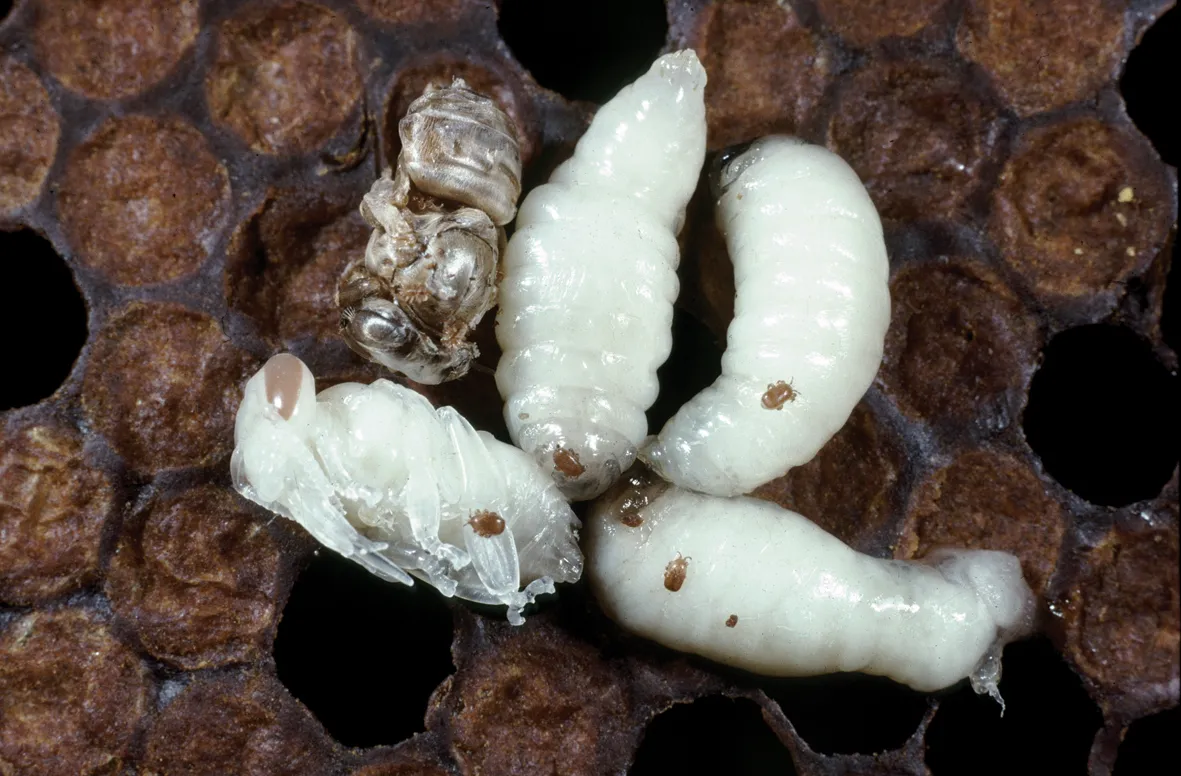

To scale, magnified
- Varroa
- Wider than long, crab-like, slow-moving
- Tropilaelaps
- Longer than wide, reddish-brown, runs fast across the comb
How close it is
Heading west
Originally
South and South-East Asia
Lives on the giant honeybee, and moved onto the western honeybee as beekeeping spread.
2024
Southern Russia
Reported established in colonies in the Krasnodar and Rostov regions.
2024
Georgia
Found in apiaries in the west of the country, by the Black Sea.
Not yet
The European Union
Not found. Experts warn the risk of it arriving through the trade in bees is significant.
Not yet
Ireland
Never found here. Keeping it that way depends on what bees come in.
Why it matters
Worse than varroa, in three ways
It breeds faster
Its life cycle is shorter than varroa’s, so numbers in a colony can climb far more quickly.
It hides in the brood
It can only feed on brood, so it spends nearly all its time out of sight under the cappings.
It’s easy to miss
It is small and fast, and its damage looks like varroa’s: patchy brood, and bees with stunted wings.
Keeping it out
What every beekeeper can do
Do
- Buy bees, queens and nucs from local Irish beekeepers.
- Keep a varroa floor insert in, and look at the debris. A long, narrow, fast-running mite is worth reporting.
- Learn what it looks like, and tell other beekeepers.
Don’t
- Don’t import bees or queens, or buy them online from abroad.
- Don’t bring used hives or comb in from outside Ireland.
- Don’t assume an unusual mite is just varroa.