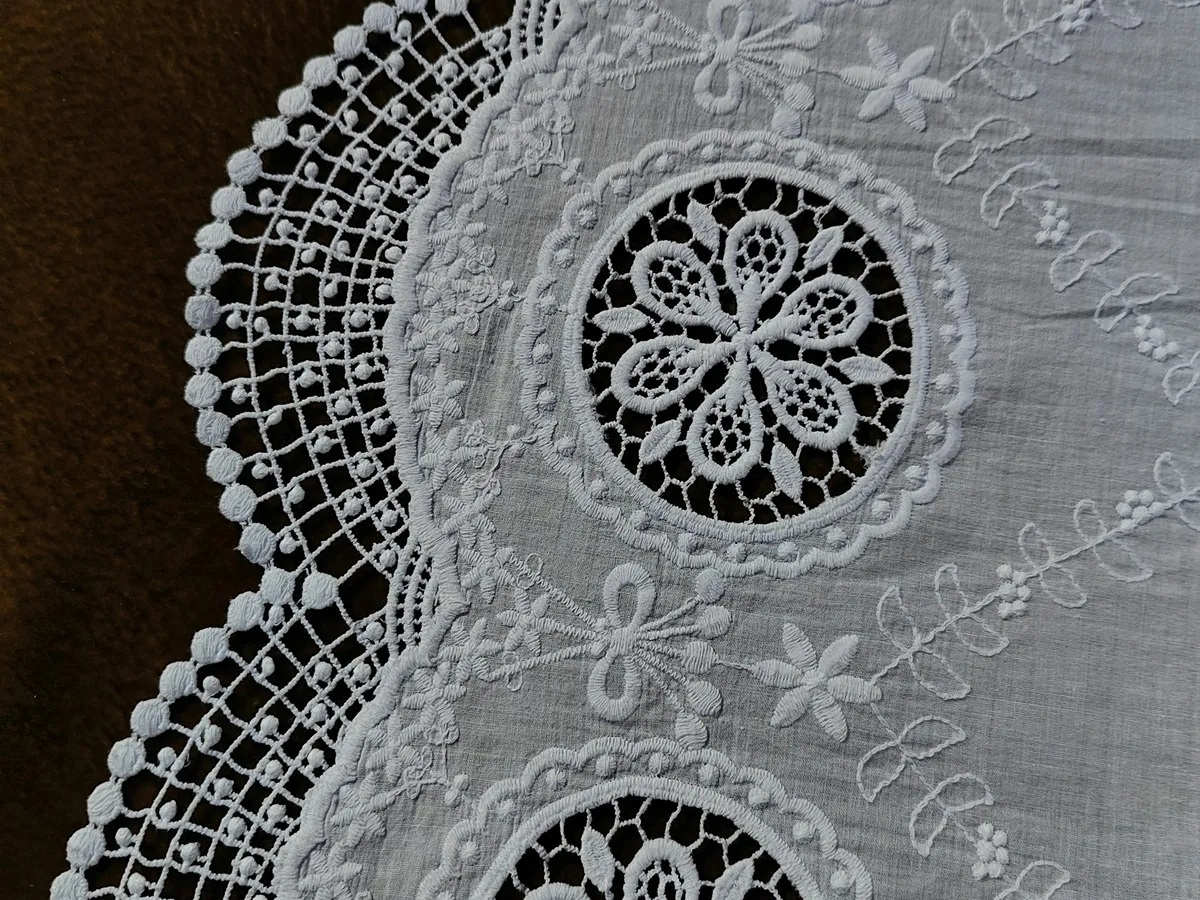
Limerick lace isn’t woven or knotted from scratch. It’s embroidery: patterns of flowers, leaves and scrolls worked by hand into the finest of nets, so delicate they seem to float.
For nearly two hundred years it has been one of Ireland’s best-known laces, worn at weddings and christenings and made for collars, veils and altar cloths. Every piece is the work of a single pair of hands, and many hours.
Two techniques
Tambour and needle-run
Tambour
Worked with a fine hook
The net is stretched tight on a round frame, like a drum (tambour is French for drum). A tiny hook pulls thread up through the net in a chain of loops, drawing the outlines of the pattern.
Needle-run
Worked with a needle
A needle runs thread in and out of the mesh, outlining each shape and then filling it with darning and fancy stitches. Finer and slower, with more texture.
A Limerick story
Two centuries of lace
1829
A factory at Mount Kennett
Charles Walker, an English businessman, sets up a lace works in Limerick city and brings young women over from Coggeshall in Essex to teach the craft. They start with tambour work.
Late 1830s
Needle-run arrives
Needle-run lace joins tambour, and Limerick lace becomes known for both.
1860s
The machines win
Cheap, machine-made lace from Nottingham floods the market, and the big Limerick lace factories close.
1880s
The revival
Florence Vere O’Brien gathers former lace makers to work from home, raises the standard of design, and finds buyers for their lace.
1893
A lace school
She opens a lace school on George’s Street, now O’Connell Street, to teach new makers and sell their work.
Today
Still made by hand
Limerick lace is kept alive by makers, teachers and collectors, and treasured pieces are handed down in families.
Learn it by hand
Join a Limerick lace workshop
Get in touch to ask when our next Limerick lace workshop is on, or about bringing one to your school, club or community group.