European foul brood is a bacterial disease of honeybee brood. It kills young larvae before their cells are capped, and it spreads quietly from colony to colony, so the sooner it’s spotted, the better.
It’s caused by Melissococcus plutonius, which larvae swallow with their food. The bacteria multiply in the gut and starve the larva of what it eats. A strong colony with plenty of nurse bees can sometimes hold the disease back for a while, which is exactly why it’s easy to miss: the signs come and go until, often in early summer, they don’t.

Know the difference
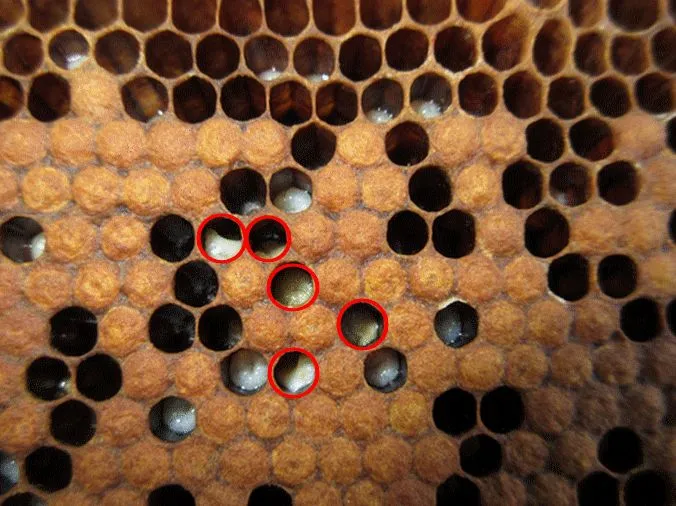
Healthy brood, and brood with EFB
Twisted, slumped larvae
A healthy larva lies curled in a neat C at the bottom of its cell. EFB larvae die before the cell is capped, and are left twisted, stretched out or slumped against the cell wall.
Pearly white turns yellow, then brown
Sick larvae lose their glossy white and go creamy yellow, then brown, often looking melted. You may see the gut through the skin as a pale streak.
Patchy “pepper-pot” brood
Dead larvae are cleared out, leaving a scatter of empty cells among the capped ones, instead of a solid sheet of brood.
Also watch for
- A sour, unpleasant smell when the brood box is opened.
- Dried remains (scales) that lift out of the cell easily, unlike American foul brood.
- A colony that stays weak or dwindles in early summer, when it should be building up.
How it travels
Carried on bees, comb and hands
EFB moves wherever infected bees, brood or honey go. Bees carry it when they rob a weak colony or drift into the wrong hive. Beekeepers carry it too, more often than anyone would like: by swapping frames between colonies, by sharing hive tools and gloves, and by buying in bees or used equipment without knowing where they came from.
Good hygiene is the best defence: your own clean kit for each apiary, no swapping frames between colonies you haven’t checked, and comb replaced regularly.
If you think you’ve found it
Three things to do
Close up and stay put
Put the frames back and close the hive. Don’t move bees, frames or equipment to or from that apiary.
Report it
EFB is notifiable: by law you must tell the Department of Agriculture. Email them with your location and what you saw.
Follow the inspector
An inspector will confirm it and advise. Lightly affected colonies can sometimes be saved on clean comb; badly affected ones are destroyed.
Department of Agriculture, Food and the Marine: beekeeping@agriculture.gov.ie